

Beta Feature - Deliberation and Grand Deliberation modes are currently in beta. Functionality may change as we refine the multi-analyst system.
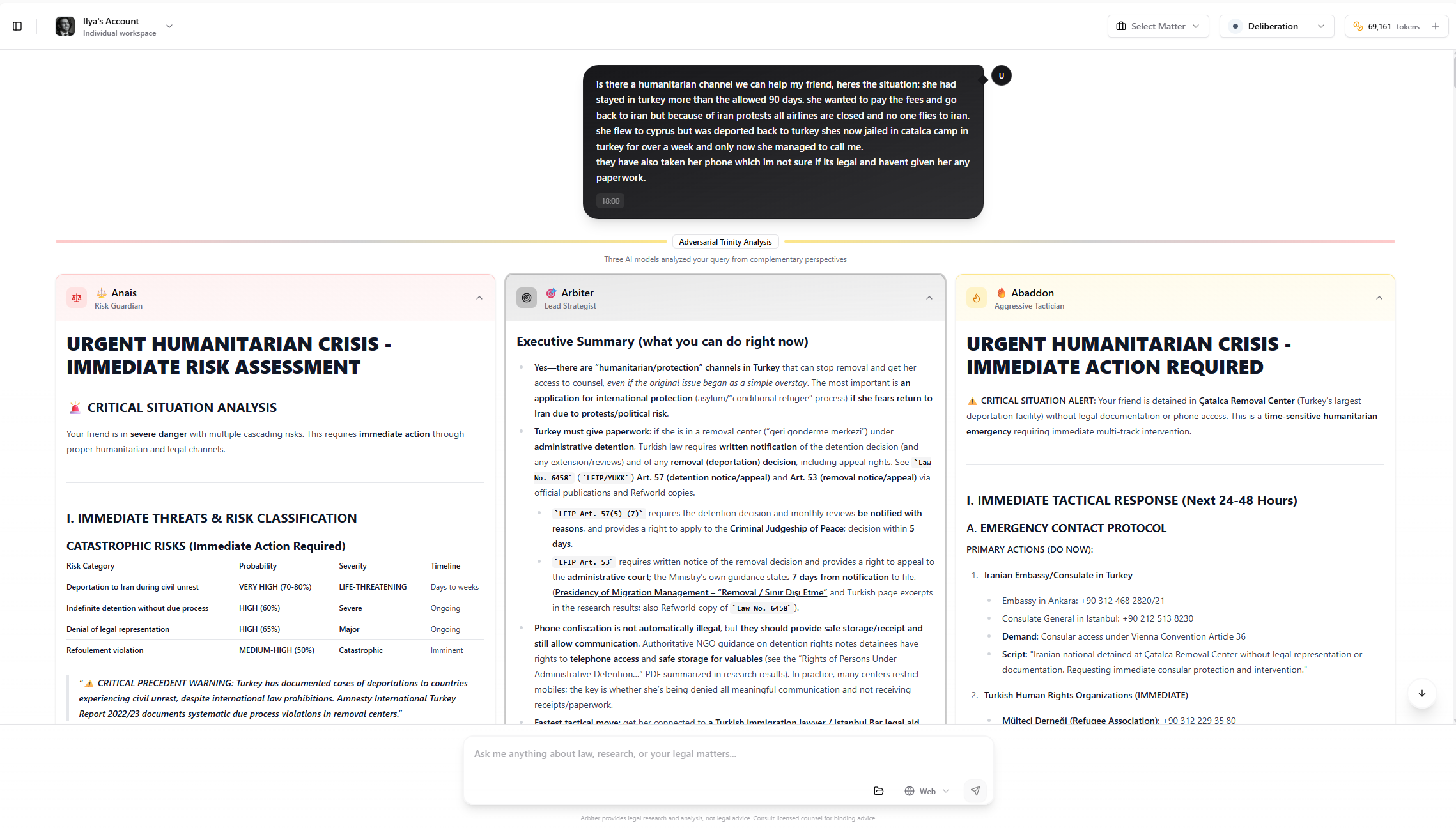
Why Multiple Perspectives Matter
Legal problems rarely have a single right answer. The best counsel considers multiple angles: what’s legally sound, what minimizes risk, and what achieves the client’s objectives. Arbiter’s Deliberation modes replicate this by deploying three AI analysts simultaneously, each approaching your question from a distinct vantage point. This adversarial approach is particularly valuable when:- You’re advising a client on strategy and need to present balanced options
- There are competing interests or potential conflicts to navigate
- The legal question involves risk/reward tradeoffs
- You want to stress-test your own analysis before presenting it
The Adversarial Trinity
Arbiter
Lead StrategistBalanced, practical analysis weighing precedent, policy, and real-world outcomes. Synthesizes the other perspectives into actionable guidance.
Anais
Risk GuardianConservative perspective focused on compliance, ethics, and downside protection. Flags potential pitfalls, regulatory concerns, and reputational risks.
Abaddon
Aggressive TacticianCreative, assertive approach that identifies leverage points, novel arguments, and maximum-value strategies. Proposes options you might not have considered.
The Three Modes
Standard Mode
Single Analyst • Fast Turnaround In Standard mode, only Arbiter responds. This is appropriate for:- Routine legal questions with straightforward answers
- Quick lookups of statutory provisions or regulations
- Preliminary research before deeper analysis
- Low-stakes or time-sensitive inquiries
Token usage: ~10-30 tokens per query
Deliberation Mode
Three Analysts • Cross-Aware Dialogue All three analysts work in parallel. Critically, each analyst can see what the others are saying and refines their analysis in response. This produces more nuanced, battle-tested conclusions than any single perspective. Deliberation is appropriate for:- Questions involving multiple jurisdictions or regulatory regimes
- Strategic decisions with meaningful risk/reward tradeoffs
- Situations where you need to present options to a client
- Legal questions with unsettled or developing doctrine
Token usage: ~30-60 tokens per query
Grand Deliberation Mode
Premium Reasoning • Maximum Depth Grand Deliberation uses the same three-analyst approach but with extended reasoning capabilities. Each analyst engages in deeper, multi-phase analysis before contributing. This is Arbiter’s most thorough mode. Reserve Grand Deliberation for:- Critical strategic decisions (significant liability, major transactions)
- Complex multi-jurisdictional or multi-party matters
- High-stakes advice requiring maximum analytical rigor
- Situations where you need comprehensive documentation of the analysis
Token usage: ~60-150 tokens per query
How the Cross-Aware Dialogue Works
In Deliberation modes, the three analysts don’t simply work in isolation. The process unfolds in phases:1
Initial Analysis
Each analyst independently forms their initial perspective on your question.
2
Cross-Reading
Each analyst reviews what the other two have said.
3
Refinement
Each analyst refines their position in response to the others, acknowledging valid points and distinguishing where they disagree.
4
Synthesis
A final synthesis integrates all three refined perspectives, highlighting areas of agreement, key disagreements, and a balanced recommendation.
Reading the Three-Column Output
When you receive a Deliberation or Grand Deliberation response, you’ll see three panels:
Below the three panels, a Synthesis section:
- Identifies points of agreement among the analysts
- Highlights key areas of disagreement and why
- Provides a balanced recommendation
- Notes which perspective to prioritize depending on your client’s risk tolerance and objectives
Reasoning Transparency
All modes include expandable reasoning summaries (click the purple card to expand):- Standard Mode
- Deliberation Mode
- Grand Deliberation
- Single reasoning card showing Arbiter’s thought process
- Key factors considered
- How conclusions were reached
- Understanding the basis for conclusions
- Documenting your diligence process
- Explaining AI-assisted analysis to clients or supervisors
- Identifying which assumptions to verify independently
Practical Examples
M&A Structure Analysis (Grand Deliberation)
M&A Structure Analysis (Grand Deliberation)
Question: “Analyze the tax and regulatory implications of structuring this acquisition as an asset purchase versus a stock purchase. The target is a Delaware corporation with California employees. We’re concerned about federal antitrust review.”Why Grand Deliberation: Multi-jurisdictional analysis across tax, corporate, employment, and antitrust. High-stakes strategic decision where maximum analytical depth is warranted.Expected Output: Arbiter provides a balanced comparison of the two structures. Anais flags regulatory risks (antitrust, employment liabilities assumed). Abaddon proposes creative structuring options to optimize tax position or minimize regulatory exposure.
Contract Negotiation Strategy (Deliberation)
Contract Negotiation Strategy (Deliberation)
Question: “The counterparty rejected our proposed indemnification cap of 1x the contract value. They want unlimited indemnification for IP claims. What are our options?”Why Deliberation: Need balanced market context (what’s standard), risk perspective (exposure if we accept), and aggressive tactics (leverage points and alternatives).Expected Output: Arbiter analyzes market standards for similar deals. Anais quantifies the risk exposure and flags specific IP concerns. Abaddon proposes counter-strategies (carve-outs, insurance requirements, knowledge qualifiers).
Litigation Response Strategy (Deliberation)
Litigation Response Strategy (Deliberation)
Question: “We received a demand letter alleging trade secret misappropriation by a former employee we hired six months ago. The letter demands immediate injunctive relief and threatens suit. What are our response options?”Why Deliberation: Need risk assessment (liability exposure, injunction likelihood), strategic options (settle, fight, negotiate), and balanced recommendation.Expected Output: Arbiter outlines the landscape and likely timeline. Anais assesses litigation risk and potential damages. Abaddon proposes aggressive defense strategies and potential counterclaims.
Regulatory Filing Question (Standard)
Regulatory Filing Question (Standard)
Question: “What are the filing requirements and timeline for Form D under Regulation D after closing a Series A round?”Why Standard: Straightforward regulatory question with a clear, settled answer. No meaningful tradeoffs to analyze.
When to Use Each Mode
Token and Time Summary
Grand Deliberation uses more tokens but provides correspondingly deeper analysis. Match the mode to the importance of the question.
Best Practices
Match Depth to Stakes
Don’t use Grand Deliberation for simple questions, and don’t use Standard for critical strategic decisions. The analytical depth should match the importance of the matter.
Read All Three Perspectives
In Deliberation modes, resist the temptation to skip to the synthesis. The individual analyst perspectives often contain the most actionable insights.
Use for Client Presentations
The three-perspective format translates well to client advice. It demonstrates you’ve considered the question from multiple angles and can present balanced options.
Enable GitLaw Research
Enable web research in Deliberation modes. Each analyst will incorporate current law, recent cases, and regulatory developments into their analysis.
Troubleshooting
Analysis taking longer than expected
Analysis taking longer than expected
Deliberation (2-5 minutes) and Grand Deliberation (10-30 minutes) involve multiple analysts working in sequence. Complex questions with web research enabled take longer. This is normal.
Analysts reaching similar conclusions
Analysts reaching similar conclusions
For clear-cut questions, the three perspectives may converge. This indicates strong consensus and should increase your confidence in the conclusion. To see meaningful divergence, ask about questions with genuine strategic tradeoffs.
Need to leave during Grand Deliberation
Need to leave during Grand Deliberation
You can navigate away during a Grand Deliberation session. The analysis will continue, and results will be available when you return.
Unsure which mode to use
Unsure which mode to use
When in doubt, start with Standard mode. It’s fast, reliable, and sufficient for most legal questions. Escalate to Deliberation when you specifically need multiple perspectives on a strategic question, and reserve Grand Deliberation for high-stakes matters requiring maximum analytical depth.
Next Steps
AI Research
Overview of research capabilities and the Adversarial Trinity in action
GitLaw
How Arbiter performs verified legal research